

Yoga after Hiking: The Best Yoga Poses for Muscle Recovery
Yoga after hiking is one of the simplest ways to help your legs recover, so the next morning feels a lot kinder. Hiking can be tough on your hips, hamstrings, calves and ankles, and a few well-chosen poses help settle them down once you’re back.
We’ve been pairing hike and yoga on our retreats since 2006, here’s what we’ve learnt: why it works, the best poses for every level, and what to skip.
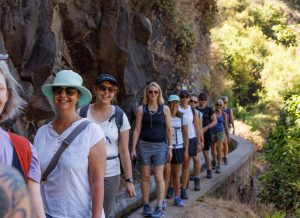
Why post hike yoga is worth it
After a few hours on the trail, your muscles shorten and tighten, especially through the hips, hamstrings and calves. Post hike yoga gently lengthens them again, so you’re less likely to wake up stiff.
It also helps in a few less obvious ways:
- It eases your lower back. Carrying a pack and leaning into climbs both load the lower back. Gentle twists and folds give it a break.
- It keeps your hips moving. Hiking only moves your legs forwards and backwards. Yoga takes them through the other directions, which keeps your stride comfortable over time.
- It helps you switch off. Slow breathing after a long day tells your body the hard work is done, which makes it easier to rest.
- It helps you spot niggles early. A few quiet minutes on the mat is a good time to notice a tight calf or a grumbling knee before it becomes a problem.
Yoga before a hike helps too, mainly by warming up your joints so your first climb doesn’t come as a shock.
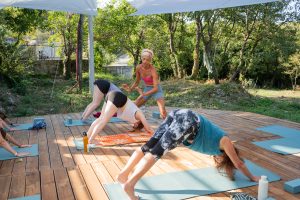
A quick warm-up before you set off
Before a hike, keep it moving rather than holding long stretches. Move in and out of each pose with your breath.
- Cat-cow. On all fours, arch and round your back five to eight times to loosen your spine.
- Low lunge. Step one foot back, lower the back knee and shift your hips forward for three to five breaths each side. It opens the hip flexors that power every uphill step.
- Downward-facing dog. Lift your hips into an upside-down V and pedal your feet to wake up your hamstrings and calves.
- Ankle circles and calf raises. Not glamorous, but strong, mobile ankles cope far better with rocky ground.
When to warm up, and for how long
As close to setting off as you can, ideally within 30 minutes of your first step. Any earlier and your body cools back down before you’ve reached the trailhead.
A pre-hike routine only needs 5 to 10 minutes. Run through the poses above once or twice and you’re good to go. On our retreats, we do morning yoga first, have a quick breakfast, then head straight out the door, so your muscles are still warm and stretched when the hike begins.
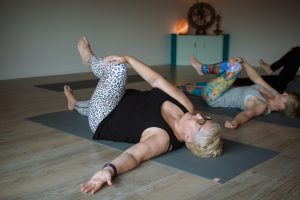
The best yoga poses after hiking
After a hike, slow everything down. Hold each pose for 30 seconds to a minute and let your breathing do most of the work. Start with the beginner poses, and only move on to the next level if your body feels ready for it that day.
Beginner yoga stretches after hiking
- Reclined figure four. Lie on your back with knees bent, cross one ankle over the opposite knee and draw both legs towards you.
Why it helps: it stretches the glutes and outer hips, which do a lot of braking on the way down. - Reclined hamstring stretch. Lie on your back, loop a strap, towel or belt around one foot and raise the leg, keeping a slight bend in the knee.
Why it helps: the floor supports your back, so tired hamstrings and calves can let go without any strain. - Supine twist. Hug your knees in, then let them fall to one side with your arms stretched out.
Why it helps: it releases the lower back after hours of carrying a pack. - Legs up the wall. Lie with your legs resting up a wall for five minutes or so.
Why it helps: it takes the weight off your feet and legs and is one of the easiest ways to wind down.
Intermediate poses
- Low lunge with a quad stretch. From a low lunge, bend the back knee and reach back for your foot, or use a strap.
Why it helps: it stretches the hip flexors and the front of the thigh together, both of which tighten on long climbs. - Half splits. From a low lunge, shift your hips back over the back knee and straighten the front leg, flexing the toes towards you.
Why it helps: it lengthens the hamstrings and calves in one go. - Garland pose (yoga squat). Feet a little wider than hips, toes turned out, sink your hips low and bring your palms together. Sit on a block if your heels lift.
Why it helps: it opens the hips and stretches the ankles and Achilles, which work constantly on uneven ground.
Advanced poses
- Pigeon pose. From all fours, bring one knee forward behind your wrist and slide the other leg back, then fold over the front leg.
Why it helps: it’s one of the deepest stretches for the glutes and outer hips. Skip it if your knees are sore. - Lizard pose. From a low lunge, bring both hands inside the front foot and lower onto your forearms if that’s comfortable. Why it helps: it reaches deep into the hip flexors and inner thighs.
- Reclined hero. Kneel and sit between your heels, then lean back onto your hands, forearms or a bolster.
Why it helps: a strong stretch for the quads and the front of the ankles. Only do this one if your knees are completely happy.
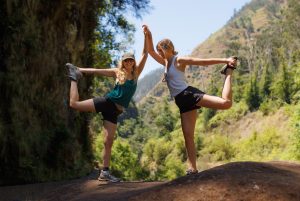
When to do post hiking yoga, and what to go easy on
Within an hour or so of finishing is ideal, while your muscles are still warm. Have a drink and a snack first, change out of damp layers, then roll out your mat. If you can’t fit it in straight away, a short session before bed still helps.
After a particularly long or tough hike, a few things are worth avoiding:
- Pushing for depth. Tired muscles stretch further than usual, which makes it easy to overdo it. Aim for a comfortable stretch, never a strain.
- Strong standing or balancing work. Save warriors and balances for another day. Your legs have done enough.
- Hot yoga. If you’re already a bit dehydrated, a heated room adds to the problem.
- Stretching through pain. Sharp or joint pain, particularly in the knees or ankles, is a sign to stop. If it hangs around for more than a few days, see a GP or physio.
Yoga for hiking training
On the days you aren’t hiking, yoga can build the strength, balance and mobility that make the next hike feel easier.
- Chair pose for strength. Sit back as if into a chair, arms up. It works the quads and glutes you need for steep climbs.
- Warrior II for stamina. Feet wide, front knee bent, arms reaching. Holding it builds endurance in the legs and opens the hips.
- Tree pose for balance. Stand on one leg, the other foot resting on your calf or inner thigh. Good practice for rocky paths and stepping stones.
- Warrior III for stability. Tip forward on one leg until your body forms a T. It strengthens the ankles, hamstrings and core, which all help on uneven ground.
- Bridge pose for the back body. Lie on your back, knees bent, and lift your hips. It strengthens the glutes and supports your lower back.
- Low lunge and pigeon pose for mobility. Opening the hips regularly keeps your stride long and comfortable.
How often should hikers do yoga?
If you hike most weekends, two or three sessions a week of 20 to 30 minutes is plenty to notice a difference. Add the short warm-up and cool-down around each hike and you’ve got a routine that fits around real life. Little and often beats one long session a month every time.
New to yoga? Start here
You don’t need to be flexible, and you don’t need to touch your toes. Plenty of our guests are keen walkers who’d never been to a yoga class before their first retreat.
Start with the handful of poses in this guide rather than a long class. Bend your knees as much as you like, use a strap or cushion if something feels out of reach, and keep your breathing slow and steady. If you can, try a beginner’s class or two so a teacher can check your alignment. Then stick with it: ten minutes, a few times a week, will do more than you’d expect.
The mistakes we see most often
- Long, deep stretches before setting off. Holding stretches on cold muscles can leave your legs feeling flat. Keep pre-hike yoga moving.
- Bouncing into a stretch. Ease in gradually instead. Bouncing makes muscles tighten up to protect themselves.
- Skipping your after hike yoga because you’re tired. That’s exactly when it helps most. Five minutes is better than nothing.
- Chasing flexibility. The goal is comfortable, useful movement, not the deepest version of a pose.
- Only stretching, never strengthening. Mobility without strength won’t protect your knees on a long descent. Mix in the strength poses above.
- Holding your breath. If you can’t breathe calmly in a pose, back off a little.
Want to try it properly?
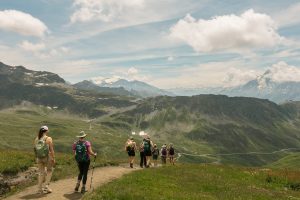
Our yoga and hiking retreats put all of this into practice. A morning class to get you moving, a guided hike through properly good scenery, then a slower session in the evening when your legs need it. We organise everything, so all you need to do is turn up in decent boots.
Come walking with us in the Peak District’s Hope Valley, along Madeira‘s mountain trails, up high in the French Alps, or through the Atlas Mountains in Morocco. If you’re after active holidays that aren’t extreme, it’s a good place to start.